
Opal and Fire Opal
July 16, 2021White opal is more common and because of its body tone, generally does not show the colour as well as black opal. … Fire opal is a transparent to translucent opal, with warm body colors of yellow to orange to red. Although it does not usually show any play of color, occasionally a stone will exhibit bright green flashes.
Fire opal stones are quite different from the opals we’ve become used to. These stones were virtually unknown to the rest of the world until the Spanish reached what’s now known as Mexico and Central America. Prior to that, the European gemstone market was fixated on a small supply of opals from Hungary.
How Is Fire Opal Formed?
Staying true to its name, fire opal stones are borne from fire. These Mexican opals are said to form in the depths of ancient volcanoes.
The fire opal is created when water seeps into the silica-enriched lava and fill its seams and hollow areas. Under the magnitude of the heat and pressure of the volcano, the lava trapped the water within itself. Eventually, the sun-bright red orange fire opal stones would manifest.
These stones were held in high regard by the Aztec and Mayan civilisations. They referred to fire opal stone as quetzalitzlipyollitli, the rough translation of which is “the stone of the bird of paradise”.
What Does “Play of Colors” Mean?
Opal’s characteristic fire, or play of colors, was long thought to be the result of iridescence. However, with the advent of scanning electron microscopes, we now know it’s a result of diffraction. This phenomenon of flashing or moving colors due to diffraction isn’t related to the body color of the opal.
The particular colors seen in an opal’s fire depend on the size of the spheres and the angle of viewing. For example, black opal gets its color from volcanic ash, but inclusions have nothing to do with the play of color. That is due entirely to the tiny silicate spheres. They must be smaller than 1,500 angstroms (Å) for blue and violet colors, but no larger than 3,500 Å to produce oranges and reds. To put that in perspective, 20,000 spheres are about the size of the period at the end of this sentence. (An angstrom is one ten-billionth of a meter).
Please note that the term “fire” typically refers to a gemstone’s dispersion. While it’s acceptable to refer to an opal’s play of color as fire, it’s not acceptable to refer to gemstone dispersion as “play of fire.” Only opals show play of color.
Assembled Opal Gems
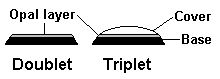
Gem cutters can take opal pieces too thin to use as a solid gemstones and assemble them into doublets and triplets.
A doublet consists of a thin layer of precious opal glued to a black base. A triplet adds a transparent quartz cap and makes a good ring stone, because the hard quartz keeps the softer opal from scratching.
Read more about Opal:
https://www.gia.edu/opal-history-lore


